skip to main |
skip to sidebar
Nemean Lion


Nemean Lion
Nemean Lion was a large lion, whose hide was impervious to weapons, which plagued the district of Nemea in the Argolis. King Eurystheus commanded Herakles to destroy the beast as the first of his twelve Labours. The hero cornered the lion in its cave and seizing it by the neck wrestled it to death. He then skinned its hide to make a lion-skin cape, one of his most distinctive attributes. Hera afterwards placed the lion amongst the stars as the constellation Leo.
Nemean Lion The mountain valley of Nemea, between Cleonae and Phlius, was inhabited by a lion, the offspring of Typhon (or Orthrus) and Echidna. (Hes. Theog. 327; Apollod. ii. 5. § 1; comp. Aelian, H. A. xii. 7, Serv. ad Aen. viii. 295.) Eurystheus ordered Heracles to bring him the skin of this monster. When Heracles arrived at Cleonae, he was hospitably received by a poor man called Molorchus. This man was on the point of offering up a sacrifice, but Heracles persuaded him to delay it for thirty days until he should return from his fight with the lion, in order that then they might together offer sacrifices to Zeus Soter; but Heracles added, that if he himself should not return, the man should offer a sacrifice to him as a hero. The thirty days passed away, and as Heracles did not return, Molorchus made preparations for the heroic sacrifice; but at that moment Heracles arrived in triumph over the monster, which was slain, and both sacrificed to Zeus Soter. Heracles, after having in vain used his club and arrows against the lion, had blocked up one of the entrances to the den, and entering by the other, he strangled the animal with his own hands. According to Theocritus (xxv. 251, &c.), the contest did not take place in the den, but in the open air, and Heracles is said to have lost a finger in the struggle. (Ptolem. Heph. 2.) He returned to Eurystheus carrying the dead lion on his shoulders; and Eurystheus, frightened at tile gigantic strength of the hero, took to flight, and ordered him in future to deliver the account of his exploits outside the gates of the town.
Hercules's 1st Labor was to kill the Nemean Lion and bring it back its pelt to the king. Arrows didn't work to kill the lion. It didn't work because the pelt was made of thick fur. Hercules threw an arrow in the lion's throat to kill it. He strangled the lion with a rope.
After Hercules killed the lion, he brought it to the king. The king gave the pelt to Hercules to use as armor so he could get through the rest of the 11 other Labors.
Nemean Lion As The Constellation Leo
Various Greek and Roman writers associate the Nemeian Lion with the constellation Leo. there are:
Pseudo-Hyginus, Astronomica 2. 24 (trans. Grant) (Roman mythographer C2nd A.D.) :
"[Constellation] Leo. He is said to have been put among the stars because he is considered the king of beasts. Some writers add that Hercules’ first Labour was with him and that he killed him unarmed. Pisandrus and many other writers have written about this."
Seneca, Oedipus 38 ff (trans. Miller) (Roman tragedy C1st A.D.) :
"[A land plaued with drought :] Titan [Helios the sun] augments the scorching dog-stars’s [Seirios'] fires, close-pressing upon the Nemean Lion’s [i.e. Leo, zodiac of mid-summer] back. Water has fled the streams, and from the herbage verdure."
Seneca, Hercules Furens 942 ff :
"[Herakles driven mad by Hera believes the constellations are attacking him :] Whence do so many stars fill the sky though it is day [i.e. there is a solar eclipse]? See where the [Nemean] lion, my first toil, glows in no small part of heaven [constellation Leo], is all hot with rage, and makes ready his fangs. Forthwith he will seize some star; threatening he stands with gaping jaws, and breathes forth fires, and shakes the mane upon his flaming neck; whatever stars sickly autumn and cold winter with its frozen tracts bring back, with one bound will he o’erleap, and attack and crush the neck of the vernal Bull [Taurus]."
sources:
Dictionary of Greek and Roman Biography and Mythology.
http://mrdfourth90.com/all_class_sites/2010/Greek_Myths/data/labor1.htm
http://www.theoi.com/Ther/LeonNemeios.html
Typhon the Greek Legend


Typhon the Greek Legend
Origin
Born of Mother Earth Gaia and Tartarus, he commands the fierce destructive winds of the world, which he used on land to destroy crops and in water to sink ships and drown sailors.
Description
Typhon was the largest and most grotesque of all creatures that have ever lived. He was so tall that he towered over the highest mountains, and his head often brushed the stars. He was of human form down to his thighs, but he had huge snake coils instead of legs. When the coils were drawn out, they reached all the way to his head and let out a loud hissing.
A hundred dragons’ heads sprung from his shoulders and his body was covered with feathers. His body was winged: scruffy hair streamed on the wind from his head and cheeks; and fire flashed from his eyes.
He made sounds of a bull, lion, and dog, and has even been said to have made hissing sounds like a snake.
Story
After the defeat of the Giants against the Olympian gods, Gaia brought forth Typhon, a super-Giant. He was larger and stronger that any of Earth's other children.
One time Typhon challenged the heavens and the gods were so frightened by Typhon's features that they fled to Egypt and disguised themselves among the wild. Only Athena stood her ground and accused the Great Zeus of cowardice.
Zeus had to defend Mount Olympus so he threw bolts of lightning at Typhon. Typhon fought back with force and cut off several of Zeus' muscles from his hands and feet, leaving him helpless.
Typhon had his sister, Delphyne, guard the muscles in a cave, but Hermes and Pan tricked her and the muscles were returned to Zeus. Zeus became even more distraught and threw more thunderbolts at Typhon. Typhon fled around the world and in Sicily Zeus threw Mount Etna on top of him, which crushed Typhon. It is said to this day that the flames and steam that rise from the volcano are from Typhon.
Typhon fathered a foul brood of other monsters on Echidna from pieces of his body torn by Zeus' stricking thunderbolts: the Chimaera, the Nemean Lion, Orthus (two-headed dog) and Cerberus, the Hydra of Lerne, Ladon (a sleepless dragon that guards the golden apples of the Hesperides garden), the Sphinx, Prometheus' eagle, and Phaea, the Crommyonian sow.
Typhon is the offspring of Gaia and Tartarus. His mate is Echidna and both were so fearful that when the gods saw them they changed into animals and fled in terror. Typhon's hundred, horrible heads touched the stars, venom dripped from his evil eyes, and lava and red-hot stones poured from his gaping mouths. Hissing like a hundred snakes and roaring like a hundred lions, he tore up whole mountains and threw them at the gods.
Zeus soon regained his courage and turned, and when the other gods saw him taking his stand, they came back to help him fight the monster. A terrible battle raged, and hardly a living creature was left on Earth. But Zeus was fated to win, and as Typhon tore up huge Mount Aetna to hurl at the gods, Zeus struck it with a hundred well-aimed thunderbolts and the mountain fell back, pinning Typhon underneath. There the monster lies to this very day, belching fire, lava and smoke through the top of the mountain.
Echidna, his hideous mate, escaped destruction. She cowered in a cave, protecting Typhon's offspring, and Zeus let them live as a challenge to future heroes. to raise their children, there are the Nemean Lion, Cerberus, Ladon, the Chimera, the Sphinx, and the Hydra.
Source:
http://monsters.monstrous.com/typhon.htm
http://www.pantheon.org/articles/t/typhon.html
Ekhidna-The-Legend-Of-Yunani


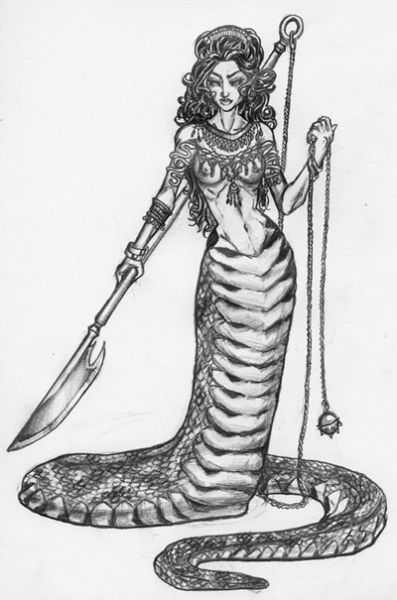


Ekhidna-The-Legend-Of-Yunani
EKHIDNA (or Echidna) was a monstrous she-dragon (drakaina) with the head and breast of a woman. She probably represented or presided over the corruptions of the earth : rot, slime, fetid waters, illness and disease..
She was often equated with Python (the rotting one), a dragon born of the fetid slime left behind by the great Deluge. Others call her the Tartarean lamprey, and assigned her to the dark, swampy pit of Tartaros beneath the earth. Hesiod, makes her a daughter of monstrous sea-gods, and presumably associates her with rotting sea-scum and fetid salt-marshes..
Echidna is best known for being the mother of monsters. There's not a huge library of "Echidna mythology" laying around somewhere where she does a bunch of other things. She is sometimes confused with Python of Greek mythology who guards the Garden of Hesperides, though that role is actually that of her child Ladon..
Like many of history's mothers, Echidna's legacy is destined to be carried on by the children she left behind. She herself was thought to preside over the corruption, rotting, and pestilence of the lower dregs of the earth. Most myths have her residing in Tartarus (Greek mythology), who is both a storm-pit of the underworld and father to Typhon..
The Children of Typhon and Echidna:
There are still debates on which monsters are, in fact, the children of Typhon and Echidna, so I basically went through them all and took the most commonly attributed ones, being:
Cerberus - the three-headed dog that guards the entrance to Hades.
Chimera - Part-lion, part-goat, part-snake - all monster.
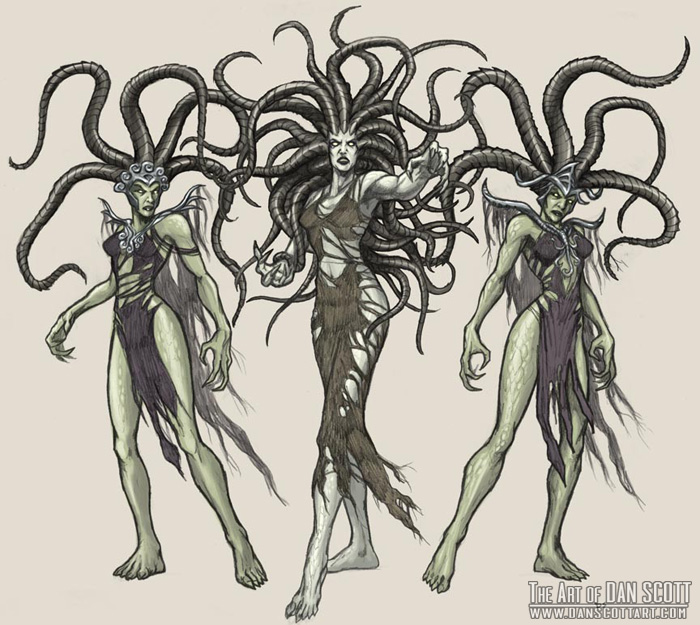
Gorgon - the snake-haired and snake-bodied humanoid that was created in its mother's image. Its stare could turn a person to stone. Medusa became one of these creatures in a later myth.
Hydra - the nine-headed serpent who grew two new heads for every one that was cut off.
Ladon (Python) - the snake that guarded the golden apples in the Garden of the Hesperides.
The Nemean Lion - the giant lion with impenetrable hide who becomes the constellation Leo.
Orthros - the two-headed dog that lived with giants.
The Sphinx - the half-human, half-lion that forces those its meet to answer its riddles, or die.
for more information, please visit these webs:
http://www.theoi.com/Ther/DrakainaEkhidna1.html
http://www.gods-and-monsters.com/echidna-mythology.html


